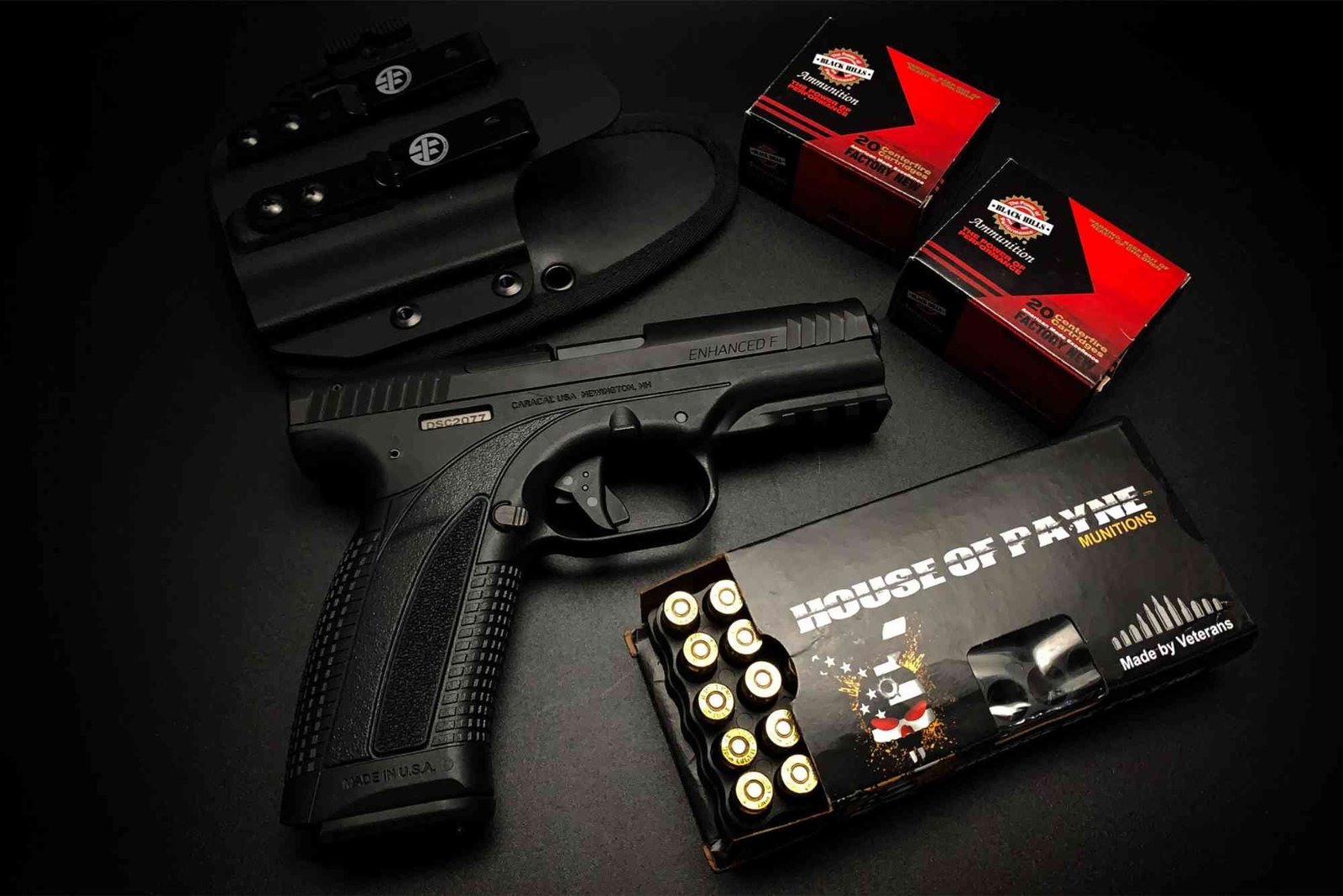
From pistols to machine-guns: how Caracal is carving its niche
Founded in 2007, the UAE-based company Caracal emerged as the small-arms specialist within the broader EDGE group, and over the past decade plus it has grown aggressively, expanding both its product range and its international footprint. Starting from a semi-automatic pistol it has moved into assault rifles, sniper systems and now machine-guns. Its ambition: to become a serious global competitor, not simply a regional supplier.
Roots, growth and global outreach
Caracal’s headquarters are in Abu Dhabi, United Arab Emirates, and the choice of location is strategic: the UAE offers strong financial backing, streamlined export licensing (while still ensuring compliance with export-control standards) and a favourable logistical position between markets in the Middle East, Africa and Asia. In its early years much of its production served the domestic market; by 2014 about 80 % of output was retained for national use, with 20 % exported. By 2022 that ratio had flipped—exports now account for roughly 60 %, with 40 % staying within the UAE. Year-on-year growth of about 8 % has been reported.
With international ambition in mind, Caracal set up a subsidiary structure to oversee operations outside the UAE under the umbrella of Caracal International. This includes a US-based arm (Caracal USA in Idaho) for the North American market, and a European presence via Germany’s Merkel (which also owns Haenel), located in Suhl and focusing on hunting arms as well as defence-oriented small arms. These overseas affiliates allow Caracal to tap local markets, manufacturing expertise and export channels while leveraging its core UAE capabilities.
Manufacturing, R&D and capabilities
At its Abu Dhabi facility, situated in the Tawazun Industrial Park, Caracal houses its research & development, prototyping and production operations. The firm utilises three 3D printers for rapid prototyping (polymer) and benefits from a metal 3D printer available via the EDGE group. Annual or monthly production capacities are impressive: roughly 3,000 pistols, 500 submachine-guns, 4,000 assault rifles and 500 sniper rifles per month. While much of the work is carried out in-house, the firm is increasingly sourcing from local or second-tier suppliers (including dual-sourcing strategies via India) to build resilience into its supply-chain.
Barrel manufacture is fully in-house: hammer forging is the technique used for assault-rifle barrels, and heat-treatment and finishing are internal operations. Polymer parts too are produced internally, and Caracal is working on developing its own polymer formulations to meet the unique demands of its weapons. Coating processes such as Cerakote or phosphate finish are part of the company’s capabilities — and in the future, Caracal hopes to position itself as the EDGE group’s specialist in coatings.
Quality assurance is robust: the facility includes a 25-metre indoor shooting range where every produced weapon is tested. For assault rifles the testing regimen involves 20 rounds: five for accuracy, five for action, and ten for rate-of-fire. Pistols and sniper rifles undergo 10-round tests. In addition, adjacent to Caracal’s location is the Abu Dhabi Proof House (operated by the local government and internationally accredited under the C.I.P. standard), which provides certification for portable firearms and ammunition.
Product evolution and portfolio
Caracal’s product evolution has been deliberate and steady. It began with a semi-automatic pistol, then in 2014 launched a 5.56 × 45 mm assault rifle, followed by a sniper rifle in 2017, and most recently introduced a light machine-gun in 2023 – marking a full spectrum small-arms portfolio. Current offerings include:
- A pistol (9 × 19 mm) – its initial product.
- The CAR 816 assault rifle (5.56 × 45 mm).
- The CAR 817 assault rifle family (7.62 × 51 mm).
- Bolt-action sniper rifles: CSR 338, CSR 308.
- Semi-automatic sniper rifle: CSA 338 (338 Lapua).
- A 12.7 × 99 mm anti-material sniper rifle: the CSR 50.
- The CLMG 556 light machine-gun.
Caracal is also working on a 7.62 mm machine-gun (announced circa IDEX 2023) and has plans for a 12.7 mm machine-gun optimized for unmanned platforms (expected readiness by 2027) — a gas-operated, manually or electrically fired weapon, designed for multi-use across air and ground unmanned systems.
When asked about introducing shotguns, Caracal’s CEO noted that current regional market demand did not justify major investment in that category. Regarding the emerging 6.8 mm calibre trend, he acknowledged that ammunition supply would be the primary bottleneck, not the weapon systems themselves — Caracal is preparing a multi-calibre platform sharing about 80 % of components with the existing CAR 817 series.
Strategic collaboration & localisation
Caracal has demonstrated strong appetite for international partnerships and localisation models. In March 2021 it signed an industrial cooperation agreement with Indonesian firm PT Pindad, under which the CAR 816 will be co-produced for the Indonesian market (Pindad supplying barrels and other key components). Then in 2023, at the IDEX show, Caracal and India’s ICOMM (part of MEIL group) entered into a licence-production partnership covering Caracal’s pistol (EF), a 9×19 mm sub-machine-gun (CMP 9), the CAR 816 (5.56 mm) and CAR 817 (7.62 mm), plus the CSR/CSA sniper family and the CSR 50 anti-material rifle. The agreement encompassed an order of 400,000 assault rifles and 4,446 sniper rifles to be produced in Hyderabad, Telangana (India), with low-rate initial production already underway for testing by Indian defence authorities. Around the same time, in May 2023, Caracal also signed a deal with Malaysian company Ketech Asia (near Kuala Lumpur) for local production and resale of the CAR 816.
Such localisation serves multiple strategic ends: it helps Caracal access regional markets more easily (by offering local manufacturing content and meeting offset or industrial participation requirements), it spreads risk by diversifying supply-chains and it provides competitive advantage over companies rooted entirely in Europe, which may find Asian and African markets harder to crack. Caracal offers flexibility in business models — ranging from IP licensing to joint ventures and full local manufacturing — tailored to partner-country requirements.
After-sales, logistics and support
In the defence sector, winning a contract is only half the battle — reliable after-sales support, spares provision, maintenance capability and logistic systems matter just as much. Caracal has invested accordingly: it operates a maintenance centre capable of Level 1 and Level 2 maintenance (i.e., routine servicing and more advanced repair) not just for its own weapons but for other manufacturers’ systems too. Unusually, Caracal has developed a van-based mobile workshop that travels to forward locations and becomes part of some contracts, offering flexibility and on-site support in challenging environments. To handle rising volumes and streamline delivery, Caracal has installed a fully-automated storage system with 2.5× the capacity of its previous facility — improving stock control and enabling faster dispatch times to customers across the globe.
Why Caracal matters
Why should industry watchers take Caracal seriously? Several factors stand out:
- Rapid product-range expansion: In just over a decade, Caracal has gone from pistols to a full portfolio including assault rifles, sniper systems and machine-guns.
- In-house manufacturing strength: Barrel forging, polymer parts, heat-treatment, coating and testing are largely internal — enabling control over key processes and flexibility in development.
- Global mindset and localisation: The company is not confined to domestic supply. Its focus on export, partnerships, licensed production and local content allows it to compete globally and access growth markets.
- Support and logistics emphasis: Recognising that systems must be supported throughout their life, Caracal has built maintenance, mobile workshop and automated logistics capabilities that few small-arms makers match.
- Backing and agility: Being part of the UAE defence-industrial ecosystem gives Caracal access to capital, favourable regulation and a location with geographic advantage and export-licensing flexibility.
Challenges and the road ahead
However, Caracal faces some significant challenges too. The small-arms market is fiercely competitive, with long-established Western and Eastern manufacturers already entrenched in many global procurement programmes. Militaries and law-enforcement agencies often prefer proven systems with decades of service history, which means Caracal must build credibility, reliability and cost-competitiveness. Ammunition logistics and supply-chain issues remain hurdles particularly when moving into new calibres (for example 6.8 mm). Furthermore, scaling manufacturing while maintaining quality and delivering spares globally is non-trivial. Finally, export-control regimes and political risk in some regional markets add complexity.
That said, Caracal’s roadmap appears ambitious: the introduction of machine-guns (including a 12.7 × 99 mm system for unmanned platforms) signals it is not content to be a niche player. The multi-calibre assault-rifle programme also demonstrates forward thinking. If the company can continue to deliver on cost, performance and support while securing key export orders and building local partnerships, it has the potential to become a serious choice for emerging procurement markets, especially in Asia, Africa and the Middle East.
Implications for procurement & users
For procurement agencies and end-users, Caracal offers some attractive features: first, local manufacturing and offsets are increasingly important in many countries’ defence-industrial policies — Caracal’s localisation model via India, Indonesia or Malaysia could align well. Second, integrated support (maintenance centre plus mobile workshop) means logistic tails may be shorter or more flexible. Third, a modular multi-calibre platform simplifies long-term lifecycle costs by allowing ammunition standard-changes without wholesale weapon replacement. On the flip side, buyers must assess long-term sustainability of support, global spares availability and whether Caracal’s systems have battlefield-proven track records comparable to legacy suppliers.
Conclusion
In the span of under two decades, Caracal has transformed from a regional pistol-maker into a full-spectrum small-arms producer with global ambition. Its roots in the UAE defence-industrial ecosystem, its manufacturing depth, its localisation strategy and its after-sales focus all position it well for the competition ahead. Whether it can convert potential into long-term procurement wins remains to be seen, but the signs are strong. As small-arms procurement diversifies beyond traditional suppliers, Caracal may well become a key player — particularly in markets demanding local content, flexible business models and support-friendly supply chains.
Discover fresh ideas, practical guides, and inspiring content at Grand Inventor. From business tips and tech insights to lifestyle trends and creative solutions, the platform offers valuable resources for curious readers and modern entrepreneurs. Explore expert articles, stay updated with new innovations, and find helpful information to grow your knowledge. Visit the homepage to start exploring: